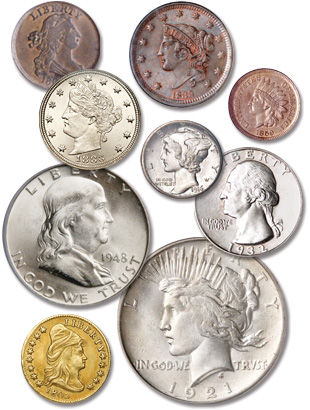

Hold a Liberty Cap half cent in your hand and travel back to colonial times. A silver 3¢ piece recalls the Civil War, while the Peace dollar echoes the glitz and glamour of the Roaring Twenties. Genuine U.S. coins not only blaze a path through America's history – they tell the country's story in a way that few other artifacts can. Why? Since our nation's beginnings, George Washington, Thomas Edison, our grandparents, parents, and even you today, have used coins!
The following is a guide to United States coinage that outlines the major design types of U.S. coins by denomination and date of issue.
Half Cent 1793-1857
Liberty Cap Left 1793 |
Liberty Cap Right 1794-1797 |
Draped Bust 1800-1808
|
Classic Head 1809-1836 |
Braided Hair 1840-1857 |
The smallest denomination U.S. coin, yet nearly the size of a modern quarter. Made of pure copper, the half cent was useful for making change during its early years of issue. But as time passed and things grew more expensive, the half cent lost its usefulness, and was abandoned shortly before the Civil War. Today, all half cents are scarce. All types carry a bust of Liberty on the obverse and a wreath on the reverse.
Large Cent 1793-1857
Flowing Hair
(Chain reverse) 1793 |
Flowing Hair
(Wreath reverse) 1793 |
Liberty Cap 1793-1796 |
Draped Bust 1796-1807 |
Classic Head 1808-1814 |
Coronet 1816-1857 |
Along with the half cent, one of the first two coins struck by the United States, all the large cents were coined at the Philadelphia Mint. With twice the copper of the half cent, they were large and heavy – greater in size than today’s quarter – so a pocketful was quite bulky. As the price of copper rose during the 1800s, the large cent became too expensive to produce and was replaced in 1857 by the small cent.
Small Cent 1856-Date
Flying Eagle 1856-1858 |
Indian Head 1859-1909 |
Lincoln 1909-Date |
Wheat Ears Reverse1909-1958 |
Memorial Reverse 1959-2008 |
Birthplace2009 |
Formative Years 2009 |
Professional Life 2009 |
Presidency 2009 |
Shield Reverse 2010-Date |
America’s first small cent, the Flying Eagle, was introduced in 1856. It was nicknamed the “white cent” because of its 88% copper and 12% nickel composition. Designed by James Longacre, the Flying Eagle cent was minted for just 3 years before being replaced with the Indian Head cent.
In 1909, the Lincoln cent became America's first circulating coin to portray a president. It originally featured the "Wheat Ears" reverse design, which was changed to the Lincoln Memorial in 1959. Then, for the series' 100th anniversary and the bicentennial of Lincoln's birth in 2009, four different reverse designs were released. A new, ongoing reverse design featuring the Union Shield debuted in 2010.
Two-Cent Piece 1864-1873
Two-Cent Piece1864-1873
The 1864 Coin Act also called for a 2¢ copper coin. This Civil War-era coin was America’s first and only 2¢ piece. It was the first coin to carry IN GOD WE TRUST.
Silver Three-Cent Piece 1851-1873
The 3¢ piece is the smallest of all U.S. silver coins. Because it was struck in silver, the public hoarded it along with other coins when the Civil War broke out. Since the 3¢ piece was needed to help ease the coin shortage caused by war, the U.S. Mint decided to strike it in copper-nickel.
Nickel Three-Cent Piece 1865-1889
The 3¢ nickel, so called because of its copper-nickel composition, was well received by the public. This coin helped the nation retire the unpopular 3¢ paper notes issued during the Civil War. Once the majority of notes had been exchanged for 3¢ coins, and production of 5¢ nickels and cents increased, the banks needed fewer 3¢ pieces.
Nickel 1866-Date
Shield 1866-1883 |
Liberty Head (“V”) 1883-1913 |
Buffalo 1913-1938 |
Jefferson Obverse1938-2004 |
Jefferson Obverse2005 |
Peace Medal2004 |
Keelboat 2004 |
Bison2005 |
Ocean in View 2005 |
Return to Monticello 2006-Date |
In 1866, the nation’s first 5¢ coin of non-precious metal was created: the Shield nickel. The prior (and first) U.S. 5¢ coin, the half dime, was silver. In 1883 came the Liberty Head or “V” nickel, followed by the extremely popular Buffalo nickel of the early 20th century, and then the long-running Jefferson nickel. In 2004, new Westward Journey Jefferson nickels were released. Commemorating the Bicentennial of the Lewis & Clark expedition, two new reverse designs were issued annually. In 2006, the popular series ended with the “Return to Monticello” coin.
Half Dime 1794-1873
Flowing Hair 1794-1795 |
Draped Bust 1796-1805 |
Capped Bust 1829-1837 |
Liberty Seated 1837-1873 |
Minted in fine silver, the famous half dime was the nation’s first 5¢ coin. It was smaller and weighed less than a nickel. Several design types were issued long before the U.S. nickel denomination began. From 1866-1873, both the half dime and nickel were struck. The half dime played an integral role in the early life of America, and is of great historic and numismatic importance.
Dime 1796-Date
Draped Bust 1796-1807 |
Capped Bust 1809-1837 |
Liberty Seated 1837-1891 |
Barber 1892-1916 |
Mercury 1916-1945 |
Roosevelt 1946-Date |
The 10¢ coin, or dime, follows closely the designs of the half dime through the Liberty Seated type. And until 1964, when production of circulating silver coinage was ceased, all circulating dimes were minted in fine silver. Dimes in higher grades are scarce and expensive, since this denomination was used extensively compared to quarters and halves. But many early dimes are still available in circulated condition at a more reasonable cost.
Twenty-Cent Piece 1875-1878
The shortest-lived coin denomination in U.S. history! The twenty-cent piece, minted in 90% fine silver, was struck for circulation only in 1875 and 1876. A few hundred Proofs were coined in 1877-1878. Soon after the coin’s appearance, people complained that it was too close in design and size to the quarter – causing problems in making change. Fewer than 1.4 million were minted, so the twenty-cent piece is a scarce and treasured item today.
Quarter 1796-Date
Draped Bust 1796-1807 |
Capped Bust 1815-1838 |
Liberty Seated 1838-1891 |
Barber 1892-1916 |
Standing Liberty 1916-1930 |
Washington 1932-1998 |
Because of the practice of cutting up the Mexican 8 Reales coin into eight parts (thus the “Piece of Eight” name), the U.S. quarter, as ¼ of a dollar, became known as “two bits.” As a silver coin of substantial size until 1964, the quarter has always been popular – both in circulation and among collectors. Several designs have been used since 1796, and many collectors try to assemble at least one coin of each type.
Delaware 1999 |
Hawaii 2008 |
District of Columbia 2009 |
Statehood, D.C. & U.S. Territories Quarters
A new era of coin collecting began with the start of America’s 50 State Quarters Program in 1999. From 1999-2008, every state in the Union was honored in the order they joined, or, in the case of the 13 original colonies, the order they ratified the Constitution. In 2009, an additional six quarters were issued, honoring the District of Columbia and five U.S. territories.
Hot Springs 2010 |
Gettysburg 2011 |
El Yunque 2012 |
America's National Park Quarters
In 2010 another series, modeled after the Statehood quarters, began – this time honoring America’s national parks and historic sites. Designs are scheduled to be released until 2021 for each of the 50 states, D.C., and the five U.S. territories in the order their locations first became national sites.
See our complete Quarter Release Schedule
Half Dollar 1794-Date
Flowing Hair 1794-1795 |
Draped Bust 1796-1807 |
Capped Bust 1807-1839 |
Liberty Seated 1839-1891 |
Barber 1892-1915 |
Liberty Walking 1916-1947 |
Franklin 1948-1963 |
Kennedy 1964-Date |
Though the half dollar is almost forgotten today, it was once the major silver coin of circulation. At one time, a half dollar was often more than a person made in a day’s labor. To have one, or perhaps two, was a significant stash of money. Because the half dollar is seldom seen today, it continues to grow in popularity.
Dollar 1794-Date
Flowing Hair 1794-1795 |
Draped Bust 1795-1804 |
Liberty Seated 1840-1873 |
Early silver dollars represent the remarkable era in America’s history when the colonies united to form what would become one of the greatest nations on Earth. Since precious silver ore was scarce in that era, the dollars of that period have very low mintages. Silver dollars were not minted between 1804 and 1836, so those that still circulated were scarce and hoarded. In addition to the early dollars pictured, a number of so-called “Gobrecht” dollars were issued between 1836-1839, and served as patterns for the Liberty Seated dollar.
Trade 1873-1885 |
Morgan 1878-1921 |
Peace 1921-1935 |
Eisenhower 1971-1978 |
Susan B. Anthony 1979-1981, 1999 |
American Eagle 1986-Date |
Sacagawea 2000-2008 |
Presidential 2007-Date |
Native American2009-Date |
Agriculture 2009 |
Government 2010 |
Diplomacy2011 |
Trade Routes2012 |
The U.S. dollar coins of the late 19th century to the present are among the most sought-after collector issues. These include Trade, Morgan, and Peace dollars struck in 90% silver, as well as the Eisenhower dollars, which were the last large-size $1 coins struck for circulation. The Susan B. Anthony coins began a new era of small-size U.S. dollars, and were followed by the Sacagawea dollars of 2000 to 2008, and the new Presidential dollar series introduced in 2007. Though originally issued for circulation, beginning in 2012 the Presidential dollars were issued in limited quantities for collectors only.
In 2009, new Native American dollars debuted, with the familiar Sacagawea obverse (with date and mint mark moved to the edge) and annually changing reverse designs. The $1 American Eagle silver bullion issues, struck in 99.93% silver, were introduced in 1986 and are the largest of all U.S. coins.
U.S. Gold Coins
Liberty Head $1 Gold 1849-1854 |
Indian Head $2.50 Gold 1908-1929 |
Liberty Head $5 Gold 1839-1908 |
Indian Head $10 Gold 1907-1933 |
Saint‑Gaudens $20 Gold 1907-1933 |
Between 1795 and 1933, the U.S. Mint produced various gold coins in the denominations of $1, $2.50, $3, $5, $10 and $20 (plus a few extremely rare $4 pattern pieces). These beautiful coins were minted in one of the world’s most precious metals, and designed by some of the finest artists of the day. Mintages were quite small, and many have been melted down over the years, so U.S. gold coins are of particular scarcity and interest today. Since 1986, American Eagle gold bullion coins have been issued just for collectors. For many, gold coins with their unmatched beauty and worldwide popularity represent the apex of enjoyment in numismatics.
U.S. Commemoratives
1892 Columbian Half Dollar – the first U.S. Commemorative |
1982 George Washington Half Dollar |
Official U.S. commemorative coins are authorized by Act of Congress to honor important persons, locations, and events in U.S. history. Commemoratives have been struck in both silver and gold, and more recently, clad. They are minted only in very small numbers compared to regular coinage. After 1954, no U.S. commemoratives were produced until 1982, when the George Washington half dollar was issued to commemorate the 250th anniversary of Washington’s birth. Official U.S. issues should not be confused with so-called “commemoratives” produced by private organizations, which are medals, not coins.