

Building a Kennedy Half Dollar Collection
The Kennedy Half Dollar Design
The charismatic John Fitzgerald Kennedy (JFK) was our nation’s youngest president elected to date. At 43, and a decorated WWII veteran, he was voted in as 35th chief executive in 1960. Then, on November 22, 1963, JFK became the first president assassinated in modern U.S. history.
Within a month, Congress passed legislation to honor the slain president on a U.S. coin. Initial discussion called for replacing George Washington on the quarter, but the president’s widow, Jacqueline Kennedy, suggested the larger Franklin half dollar instead. A Founding Father, Benjamin Franklin, had been the first non-elected official on a U.S. coin in 1948, replacing the Walking Liberty design. Chief Engraver John R. Sinnock designed the Franklin obverse; the reverse was completed by assistant engraver Gilroy Roberts after Sinnock passed away.
As Chief Engraver, Gilroy Roberts designed the obverse of the new Kennedy half dollar. It was based on a portrait prepared for Kennedy’s presidential medal and after consultations with Mrs. Kennedy, and JFK’s brother, Robert F. Kennedy.
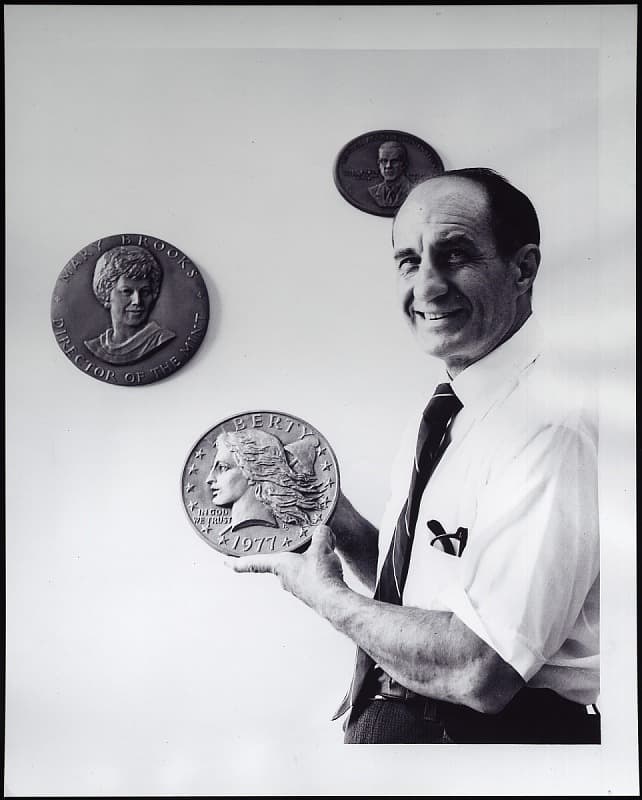
Photo courtesy of the National Museum of American History
After the first Proofs arrived in January 1964, Mrs. Kennedy requested that the hair be slightly modified so that strands right above the ear be less prominent. This alteration resulted in a one-year type design known as the Accented Hair variety.
Assistant engraver Frank Gasparro (shown) designed the heraldic eagle reverse based on the presidential seal.
The other Kennedy half dollar design is a dual-dated coin for the Bicentennial of 1776-1976, but it only was the reverse motif that changed. That design featured Independence Hall in Philadelphia in the inscription 200 years of freedom. The designer was Seth G. Huntington, an artist and sculptor, who responded to the U.S. Mint’s open competition for a special bi-centennial motif for the Kennedy half dollar.
