This note checklist is meant to help you start a $1 Federal Reserve Notes Collection. There are several ways in which people collect $1 FRNs. Some choose to collect one example of every signature combination, while others collect by blocks or by Federal Reserve Banks.
Many people add to their collections by including well-known error notes, star notes, web notes, mule notes or notes with "fancy" serial numbers (see Special Notes).
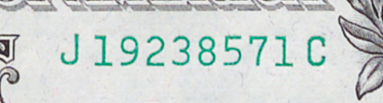
Some people collect by blocks. A block is the first and last letter in a serial number – this note comes from block JC.
What is a Web Note Dollar Bill?
A web note – also known as a web-fed or web press note – is a type of currency note printed using the web-fed printing method. Unlike sheet-fed notes, which are individually fed into the printing press, web notes were produced using a continuous roll of paper.
The Bureau of Engraving and Printing (BEP) introduced Web notes in 1988 in an attempt to reduce production costs. Web notes were known for their higher production quality and security features. But because of limitations and issues, their production was discontinued.
As a result, Web note dollar bills were issued in just three series: Series 1988A, Series 1993 and Series 1995. But due to their combination of quality, unique features and limited number of issues, these notes are gaining popularity with collectors.
How Do You Identify a Web Note?
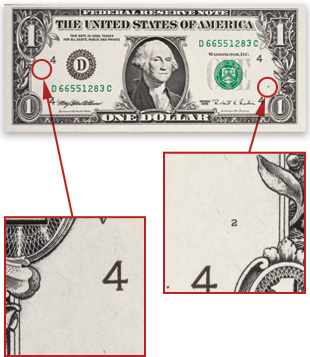
To identify a note as web-fed, look for the plate serial number at the lower right of the note's Face. If it contains a number and no letters, you have a web note.
A web-fed note also does not have a plate position number, or check letter, in the upper left corner of its face.
Finally, looking at the back of a web note dollar bill, you can find its check number. But not in its usual position to the left of the eagle. Instead, it appears to the right of "In God We Trust."
Right: A web-fed note does not contain letters in its plate serial number. Left: The absence of a plate-position number indicates a web-fed note.
How to Use This Checklist
As always, collecting is a matter of preference. You can choose notes for your collection in any way and any order you wish. Or you can use the checklist below and try our easy method for new collectors.
Look at the checklist. Beginning with the first series (1963), choose one bank letter from those listed. Circle the letter and check the box after you have collected the note. Then do the same for each of the following series until you have completed the checklist.
If you like, after you have collected one example for each series you can return to the beginning of the checklist and expand your collection by acquiring the remaining bank letters.
Collector Tip: For any note, it is best to pick the highest grade you can afford given your budget and the size of your collection. (For help with grades, see our Grading Guide).
Most importantly, remember to have fun!
This checklist is simply a helpful place to start – $1 Federal Reserve Note collecting is almost limitless in its variety.
As your knowledge increases, you'll find your own favorite notes and ways to build a Federal Reserve Note collection as unique as your imagination!
Additional Information
Since 1990, U.S. paper money has also been printed in Fort Worth, Texas at The Western Currency Facility. These notes can be identified by a small "FW" on their Face, before the plate serial number.
Although there are 12 Federal Reserve Banks that issue $1 Federal Reserve Notes, not every bank issued every series. Read more about the Federal Reserve Districts.